

Deep Work Blocks: How to Actually Protect Them: Time
This article contains affiliate links. If you buy through them, I earn a small commission at no extra cost to you — and it helps keep this site running. See my full disclosure policy for details.
Deep Work Blocks: How to Actually Protect Them
Here’s a question worth sitting with: when did “being busy” become the same thing as “doing good work”? Because I’ve spent whole days answering messages, shuffling tasks around, and feeling productively exhausted — only to realize I never did the one thing that actually mattered. If you want to know how to protect deep work time, you’re already ahead of most people, because most people haven’t even noticed the problem yet. They think the interruptions are just the job. They’re not. They’re the enemy of the job.
I’m 62 years old. I’ve been doing traditional astrology for over 40 years — the kind that requires sustained, uninterrupted thought, not a quick Google and a pretty chart printout. And since I got sober in 2023, I’ve become almost ferociously protective of my mental clarity. That clarity is not free. You have to build a fence around it.
This is how you build the fence.
What You’ll Actually Need (This Isn’t a Gear Post, But…)
You don’t need expensive gear to protect deep work time. You need decisions. But a few tools help those decisions stick — especially when your brain is already tired and looking for an excuse to check Reddit.
- A calendar you actually use (digital or paper — I don’t care, just pick one)
- A way to block distracting websites (more on that below)
- Noise management — earplugs, headphones, a closed door, whatever works in your space
- A written “not now” list for the thoughts that ambush you mid-session
- Honest self-knowledge about when your brain is actually sharp
If you haven’t read my review of Cal Newport’s Deep Work, go read that first. Newport’s the one who crystallized the concept for a generation of knowledge workers, and his framework is the foundation everything in this article builds on. I’ll wait.
Step One: Schedule the Block Like It’s a Doctor’s Appointment You Can’t Cancel
Most people “try to find time” for deep work. That’s your first mistake. You don’t find time — the day eats it before you even notice it’s gone. You make time by putting it on the calendar with the same non-negotiable energy you’d give a root canal.
Pick a window. Mine is mornings — first thing, before email, before news, before my husband Lonnie is fully awake and wants to tell me about the weird dream he had. Two hours minimum. Three is better. That window gets blocked on the calendar in a color that means “do not touch this, past-Ken, I’m serious.”
The research backs this up. Newport cites studies showing that even brief interruptions — we’re talking seconds — can cost you 20 minutes of recovery time before you’re back in flow. You can’t afford that math. Nobody can.
Practical tip: Schedule your deep work block at the same time every day. Consistency trains your brain — after a few weeks, your mind starts shifting into focus mode automatically when the hour arrives. Treat it like a ritual, not a suggestion.
Step Two: Make Interruption Harder Than Focus
Here’s the dirty secret nobody tells you: protecting deep work time is mostly an environmental design problem, not a willpower problem. Willpower is a finite, depletable resource. Your phone is a billion-dollar machine engineered to capture your attention. Willpower loses that fight every single time.
So stop bringing willpower to a gunfight. Change the environment instead.
- Phone in another room. Not face-down on your desk. Another room. The mere presence of a smartphone on a desk — even face-down, even silent — measurably degrades cognitive performance. That’s not my opinion; researchers at UT Austin documented it. Put the thing away.
- Website blocker, active before you start. I use Freedom. You can use Cold Turkey, or any number of others. The key: set it up the night before, or at least before you sit down. Decision fatigue means you’ll talk yourself out of blocking if you have to do it in the moment.
- Close every tab except the one you need. Every open tab is a tiny little temptation sitting there, blinking. Close them. All of them. The internet will still be there in two hours.
- Put an actual sign on your door if you share space. Something clear and specific: “Deep work until 11 a.m. — come back then unless there’s blood.” Lonnie finds this charming. Or at least he says he does.
Step Three: Handle Your Own Brain — It’s the Loudest Interrupter
Here’s what nobody wants to admit: most interruptions don’t come from other people. They come from inside your own skull. You’re three paragraphs into something genuinely good, and suddenly you remember you need to email the dentist, or you wonder what the weather’s going to be like Saturday, or — and this one is insidious — you get a spark of a different idea and want to chase that instead.
The fix is embarrassingly simple. Keep a notepad — paper, not digital — right next to you during your deep work block. When a thought intrudes, write it down in two seconds and go back to work. That’s it. You’re not suppressing the thought; you’re parking it. Your brain stops nagging you because it trusts the thought won’t disappear. Newport calls this a “shutdown ritual” for intrusive thoughts, and it’s one of the most underrated techniques in the whole book.
I started using this method about six months after getting sober. Early sobriety is noisy inside — the thoughts come fast and don’t respect working hours. Writing them down and returning to the task at hand was genuinely one of the things that helped me rebuild my capacity for sustained focused attention when I wasn’t sure it was coming back.
“You’re not suppressing the thought; you’re parking it. Your brain stops nagging you because it trusts the thought won’t disappear.”
Step Four: Communicate Your Unavailability Like a Professional, Not an Apology
People will interrupt you if you let them — and even if you don’t. The difference between those who protect deep work time and those who don’t is largely this: the ones who succeed have told the people in their lives, clearly and without guilt, when they are unavailable.
Set an auto-reply on your email during your deep work block. Something like: “I’m in focused work time until 11 a.m. I’ll get back to you then. If this is urgent, call.” Most things aren’t urgent. The auto-reply trains people fast.
If you work in a team environment, block your calendar visibly and set your Slack status to something that communicates unavailability. “Focused work — back at 11” works. The trick is consistency. If you honor the block every day, people stop expecting you to be instantly available during it.
And if your job genuinely doesn’t allow for any protected focus time? That’s a different problem — and an important one. Newport’s got thoughts on that too. So does Greg McKeown; if you haven’t read my review of Essentialism, it tackles the organizational side of this problem in ways that will either liberate you or make you want to quit your job. Possibly both.
Step Five: End the Block Deliberately
This one sounds weird, but stay with me. How you end your deep work block matters almost as much as how you start it. If you just drift out of focus — check your phone, wander to the kitchen, let the next thing pull you — you train your brain that the boundary isn’t real. The block just dissolves into the noise.
End deliberately. At the scheduled time — not fifteen minutes early because you’re bored, not forty minutes late because you’re on a roll (that one’s harder to resist) — stop, write one sentence about where you left off and where you’re going next, close what you need to close, and say, out loud if it helps, “done.” Then transition intentionally to whatever comes next.
This isn’t precious ritual-worship. It’s neurological hygiene. Your brain learns patterns from how you behave, not from what you intend. A clean ending signals that the block was real, which makes the next one easier to enter.
Common Mistakes That Will Blow Up Your Deep Work Block
I’ve made all of these. Some of them more than once.
- Starting with email. Email first thing is like rolling in mud before a shower. You’re contaminated before the real work even begins. Do not open it until the block is done.
- Choosing the wrong time of day. Night owls who schedule deep work at 7 a.m. are just making life hard for themselves. Know when your brain actually runs at peak, and put the block there.
- Making the block too long at first. Two hours of genuine deep work is harder than it sounds if you’re out of practice. Start with 60 or 90 minutes and build up. You’re training a muscle.
- Letting “just one quick thing” inside the block. There is no such thing as one quick thing. One quick thing is the crack in the dam. Everything floods in behind it.
- Skipping the notepad. Your brain will test you. Write the intrusive thoughts down. Seriously.
Troubleshooting: When the Block Keeps Falling Apart
You Keep Getting Pulled Out by Legitimate Emergencies
If this is happening more than once a week, something structural is broken — not your focus. Either your role genuinely requires you to be on-call (which means you need to negotiate protected time explicitly with someone), or you’ve trained the people around you to treat everything as urgent. Both are fixable. Neither is fixed by white-knuckling through interruptions.
You Sit Down and Your Brain Just Won’t Engage
Two possibilities. One: you’re under-slept or physically depleted — deep work runs on sleep the way a car runs on fuel, and there’s no substitute. (I wrote about this exact problem in the context of heat and sleep disruption; the principles in this piece on sleep cycles apply year-round.) Two: your task isn’t actually well-defined. Staring at “work on the project” is not a task. “Write the opening paragraph of section three” is a task. The more specific the target, the faster the brain engages.
Technology Keeps Finding Ways In
If notifications are getting through, your blocking isn’t thorough enough. Check your Do Not Disturb settings — both on your devices and on your router-level blocker if you use one. The Focus Mode features in iOS 18 are actually quite good for this now, and worth setting up properly if you’re on an iPhone. The AI-assisted scheduling features can help you automate blocks so you’re not relying on remembering to flip a switch.
What to Actually Expect When This Starts Working
The first week is uncomfortable. You’ll feel itchy and restless for the first 20 minutes of every block. That’s normal — your brain is accustomed to constant low-grade stimulation, and the silence feels wrong. Push through it. Don’t fill it.
By week two, the itch starts coming later. By week three, some sessions you’ll be 45 minutes in before you even notice. That’s the flow state — and once you’ve felt it a few times, you’ll do almost anything to get back there.
The bigger payoff is cumulative. After a month of protected deep work time, you’ll look at what you actually produced — the pages, the analysis, the designs, the whatever-it-is-you-do-when-nobody’s-interrupting-you — and feel something that shallow busyness never delivers: genuine satisfaction with a body of work.
For me, that shows up in astrology work that I’m actually proud of — charts I’ve thought through carefully rather than skimmed, interpretations that have depth because I gave them real time. It shows up in writing that doesn’t read like it was assembled in fifteen-minute gaps between distractions. The quality difference is not subtle. It’s embarrassingly obvious, once you’ve experienced both.
One Book Worth Owning
If you want to go deeper on the philosophy and science behind all of this — not just the tactics — Deep Work by Cal Newport is still the best single book on the subject. Newport builds the case from first principles: why deep work is valuable, why it’s increasingly rare, and why that combination makes it one of the most economically and personally rewarding skills you can develop. My full review is linked above. But if you want to just grab the book:
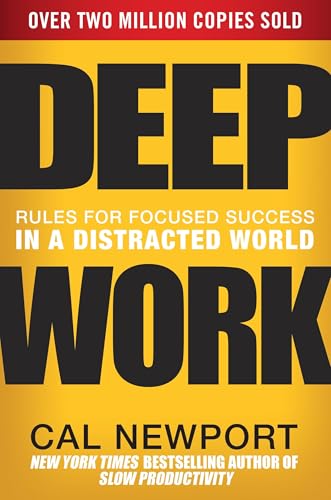
Deep Work: Rules for Focused Success in a Distracted World
Cal Newport’s foundational argument for why the ability to focus without distraction is the superpower of the modern economy — and how to develop it.
Check Price on Bookshop →The Actual Bottom Line
Learning how to protect deep work time is not a productivity hack. It’s not a life hack. It’s a values decision — a declaration that your best thinking matters enough to defend it. The world will not stop trying to fragment your attention. It will get better at it, if anything. The only counter-move is to be more deliberate than the noise.
Schedule the block. Harden the environment. Handle your own brain. Communicate clearly. End deliberately. Do it again tomorrow. The work compounds. So does the clarity. And in my experience — speaking as a man in his sixties who spent a lot of years not protecting either — the clarity is worth more than almost anything else you could spend that time on.
Want more like this? Subscribe to the weekly newsletter — tips, reviews, and the occasional unsolicited opinion on what’s actually worth your time. No noise, no fluff. Sign up at ken-saunders.com.
Now I want to hear from you: what’s the single biggest thing that blows up your deep work blocks? Is it your phone, other people, or your own brain running away with itself? Drop it in the comments — I genuinely want to know.
Get Ken’s newsletter
Honest reviews and curated finds — the gear, gadgets, books, and recipes actually worth your money. No spam, unsubscribe anytime.


