

Digital Minimalism by Cal Newport: Review
This post contains affiliate links. If you buy through them, I earn a small commission at no extra cost to you — and Bookshop pays a slice to independent bookshops, which I’m good with.
Digital Minimalism Review: Cal Newport Wants You to Put the Phone Down
Here’s a question I’d like you to sit with for a moment: when did you last go a full hour without checking something — your phone, your email, a notification, a feed? Not because you needed to. Just because the little dopamine machine in your pocket made a noise. If you had to think hard about the answer, this digital minimalism review is for you. If the answer came instantly and it wasn’t very long, it’s especially for you.
I came to Cal Newport’s Digital Minimalism sideways. I’d already read — and argued with, and underlined, and argued with again — his book Deep Work, which I reviewed over here. That book rewired how I think about concentrated effort. This one aims at something different: it wants to rewire your relationship with technology itself. As a man in my sixties who remembers life before the internet was a thing you carried around in your shirt pocket, I have complicated feelings about that project. Spoiler: the book earned them.
The Book at a Glance
Title: Digital Minimalism: Choosing a Focused Life in a Noisy World
Author: Cal Newport
Publisher: Portfolio/Penguin
My Rating: ★★★★☆ (4 out of 5)
Get It: Find it at Bookshop.org

Digital Minimalism: Choosing a Focused Life in a Noisy World
Cal Newport’s case for a radical rethink of how — and why — we use technology.
Check Price on Amazon →The Bottom Line (For Those Who Won’t Read the Whole Review)
Digital Minimalism is the clearest, most persuasive argument I’ve encountered for treating your attention as a finite resource worth protecting. Newport doesn’t want you to smash your phone or move to a cabin. He wants you to be deliberate. The philosophy is airtight. The thirty-day “digital declutter” he proposes is genuinely useful. The second half — where he suggests what to do with the time you reclaim — is patchier. But as a framework for thinking about this stuff? It’s the one I keep coming back to.
What This Book Is Actually About
Newport’s argument is deceptively simple: the problem isn’t technology, it’s the philosophy — or rather the total absence of one — that most of us bring to technology. We adopt new apps and platforms because they offer some benefit. We never ask whether the cost — in time, attention, mental bandwidth — is worth paying. Digital minimalism, as Newport defines it, is the practice of operating with a small number of carefully chosen tools that support things you deeply value, and ignoring the rest.
He opens by grounding this in something sobering: the apps and platforms competing for your attention were deliberately engineered to be hard to put down. This isn’t a conspiracy theory — it’s the business model, stated plainly. Variable-reward loops, notification design, infinite scroll. Newport names the machinery and lets it sit there, ugly and undeniable. Once you’ve seen it, you can’t unsee it. That’s probably the most valuable forty pages in the book.
The rest builds a case — philosophical, practical, occasionally repetitive — for intentional digital life. He draws on thinkers as different as Henry David Thoreau and the early users of the Amish decision-making framework for technology adoption. The writing is measured and clear, not flashy. Newport is a computer science professor, and it shows — in the best way. He’s not selling you a vibe. He’s building an argument.
Pros at a glance: Rigorous thinking. Practical thirty-day framework. Genuinely useful reframe of what “optional” means.
Cons at a glance: Second half loses momentum. Some suggestions feel dated. Occasional repetition could have been edited tighter.
The Thirty-Day Digital Declutter: Bold Idea or Just Scary?
Newport’s centerpiece practical tool is the thirty-day digital declutter — a structured break from all optional technologies, followed by a careful, intentional reintroduction. Not a detox. Not a fast. A reset with rules and a purpose. You step away from anything that isn’t essential. You sit with whatever discomfort that surfaces. And at the end, you decide what comes back — and on what terms.
Here’s why I think this actually works as a framework, even if you never do the full thirty days: it forces the question Newport wants you to ask, which is not “is this app useful?” but “does this app serve something I genuinely value, at a cost I’d willingly pay if I thought it through?” Those are very different questions. The first one almost everything passes. The second one filters ruthlessly.
The declutter is also honest about difficulty. Newport doesn’t pretend the first week won’t be weird. He writes about the phantom-phone sensation — reaching for something that isn’t there — with enough specificity that it rings true. He’s not making this sound easy. He’s making it sound worth it. That distinction matters to me. I’ve read enough recovery literature to know that anything genuinely transformative tends to be uncomfortable at the start. The thirty-day declutter has that same texture: useful friction with a purpose.
“Newport doesn’t pretend the first week won’t be weird.”
If the idea of a full month sounds like too much, Newport is actually fine with a modified version — the principle matters more than the exact duration. What you’re doing is creating enough distance to see your habits clearly. That’s the thing you can’t do while you’re still inside them.
The Deeper Philosophy: Why “Some Benefit” Isn’t Enough
This is the chapter of Newport’s thinking that I find most genuinely useful — and that most people who dismiss the book fail to engage with. He makes a distinction between something that provides some benefit and something that provides enough benefit to justify the full cost of having it in your life. We tend to adopt technology the first time it does something useful for us. We never audit it again.
Newport’s philosophical ancestors here are interesting. He spends real time with Thoreau’s concept of life as a deliberate project — the idea that how you spend your hours is, quite literally, how you spend your life. He connects this to the Amish practice of evaluating technology not by whether it offers advantages, but by whether its adoption serves the community’s core values. The Amish aren’t anti-technology. They’re rigorous about it. Newport finds that genuinely instructive, and so do I.
As someone who’s studied traditional astrology for more than forty years, I recognize this kind of thinking — the insistence that something must be evaluated in light of your actual values, not just its apparent convenience. My practice runs on a handful of core tools: a good ephemeris, reliable software, and enough silence to think. I don’t need fifteen apps to do it. Newport would approve of that setup, probably. The point isn’t Luddism. It’s discernment.
This connects directly to Greg McKeown’s work — which I went deep on in my review of Essentialism. The framing is different, but the underlying discipline is the same: protect the essential by being ruthless about the non-essential. Newport and McKeown are essentially running the same argument through different lenses. Read both.
Where the Book Gets Shaky
The first third of Digital Minimalism is close to brilliant. The middle third is solid. The final third — where Newport tells you what to fill the reclaimed time with — wobbles.
His suggestions for analog alternatives lean heavily toward the physical and the craft-based: woodworking, fixing things with your hands, joining clubs. These are fine suggestions. But they read like they were written for a specific demographic — and if you don’t fit it, you’re left to extrapolate. Not everyone wants to take up carpentry. Not everyone can. Newport’s vision of the good analog life is a little narrow, and he doesn’t seem to notice.
There’s also a moment — and I’m being precise here — where his dismissal of social media starts to feel less like rigorous analysis and more like personal distaste dressed up as philosophy. He’s not wrong that most social media use is passive and low-value. But the sledgehammer he brings to that point could use more nuance. People form real communities online. That’s not nothing. Newport acknowledges it briefly and moves on. I wanted him to stay with it longer.
And the book is not short enough for its content. A tighter edit — maybe seventy pages trimmed — would have made it sharper. You’ll feel the padding in the mid-section. Power through it.
Writing Style: The Calm Professor Who Has Clearly Thought About This More Than You Have
Newport writes like a man who has already won the argument in his head and is now patiently walking you through it. That’s not a criticism — it’s actually a relief in a genre crowded with hype and breathless urgency. He doesn’t yell. He doesn’t shame. He builds a case, brick by brick, and by the time you get to the end of a chapter you find yourself nodding, sometimes against your will.
The prose is plain and functional. Don’t come here for lyrical sentences or passages you’ll want to read aloud. Do come here for clarity. Newport can explain a complex idea in two clean paragraphs — that’s a real skill, and he uses it consistently. The occasional academic rhythm creeps in — you’ll hit a sentence that reads like a journal abstract — but it never derails for long.
What’s notably absent is personal disclosure. Newport is present as a thinker and an arguer, but rarely as a person with a history. That’s a stylistic choice, and it works for this kind of book. But if you want warmth alongside the rigor, you may find the tone slightly cool.
The Audiobook Version
There is an audiobook version of Digital Minimalism, and I’ll say this with a straight face: it’s a fine audiobook to listen to while you’re doing something with your hands. Walking. Cooking. Which is either a paradox or exactly the point, depending on your mood. The narration is clear and the pacing is steady.
That said — and I mean this — this is a book that rewards annotation. The thirty-day declutter protocol has lists and criteria you’ll want to revisit. For that reason, I’d suggest the print or e-book version for the first read. Use the audio for a refresh once you’ve already made your highlights. If you’re reading on a Kindle, incidentally, my Kindle comparison piece might help you figure out which device is worth carrying.
What This Book Actually Did to Me
I got sober in July 2023. Part of early recovery — at least for me — was becoming very honest about the things I used to escape discomfort. Alcohol was the obvious one. But I also started noticing the smaller escapes: the phone check during a conversation lull, the news refresh when I was anxious, the scroll that started because I was bored and ended because I couldn’t remember starting it. Newport doesn’t write about addiction, exactly. But his description of compulsive digital behavior — the mechanism of it, the engineering behind it — rhymes with what I know about compulsion from the inside.
That made this book hit differently than it might have a few years ago. I’m not saying social media is the same as alcoholism. I’m saying that the question — am I choosing this, or am I just doing it? — is a question worth asking about more than one thing. Newport helped me sharpen that question. That’s worth something real.
The emotional register of this book isn’t high. Newport isn’t trying to move you. But the argument accumulates, and by the end, if you’ve been honest with yourself while reading it, you’ll feel some combination of discomfort and relief. Discomfort because the diagnosis is accurate. Relief because there’s actually something you can do about it.
“The question — am I choosing this, or am I just doing it? — is a question worth asking about more than one thing.”
What’s Brilliant (and What Made Me Want to Throw It Across the Room)
Three Things Newport Gets Exactly Right
- The attention economy framing. Newport is crystal clear that the platforms competing for your time were built to capture it indefinitely. Naming this — plainly, without hysteria — is a genuine public service. Most people vaguely sense this. Newport makes it explicit and cites the people who designed the systems saying so themselves.
- The thirty-day declutter protocol. It’s concrete, it’s structured, and it doesn’t ask you to swear off technology forever. It asks you to get far enough away from your habits to see them clearly. That’s good design.
- “Solitude deprivation” as a concept. This is the part I didn’t expect — Newport’s argument that we’ve engineered solitude out of our lives, and that the consequences are measurable. The idea that being alone with your thoughts is a skill that atrophies if you never practice it stopped me cold. It’s right, and it’s uncomfortable.
Two Places Where Newport Lost Me
- The analog alternatives section. “Fix things with your hands” and “join a club” are not universally applicable. The suggestions aren’t wrong — they’re just under-examined. Newport has a specific vision of the good analog life and he doesn’t interrogate it enough. If you don’t fit his template, you’re doing the extrapolation work yourself.
- The pacing in the middle third. It meanders. Newport makes his key points early and then makes several of them again, slightly differently. A sharper editorial hand would have tightened this by at least fifty pages. Push through it — the argument is worth it — but don’t pretend it’s not there.
Who Should Actually Read This
Anyone who has looked at their weekly screen-time report and felt vaguely ashamed. Anyone who picks up their phone without knowing why. Anyone in recovery who is working on understanding compulsive behavior more broadly. Anyone who wants to do better work and suspects their attention is the bottleneck. Anyone building a reading habit — and if that’s you, the reading habit system I put together is a natural companion to what Newport is proposing here. And honestly? Anyone over fifty who remembers what it felt like to be bored without a device in your hand, and wonders if that was actually better.
My Verdict: Read It, Then Actually Try the Declutter
This digital minimalism review ends where it should: with a recommendation, unhedged. Read the book. Not because Newport has all the answers — the second half makes clear he doesn’t — but because the first half asks questions most people are actively avoiding. And the questions are better than the answers, here. Once you’ve let “does this serve something I genuinely value?” become a habitual lens, you can’t un-ask it. That’s the gift.
I’ll also say this: if you’re someone who’s been thinking about how technology intersects with your mental health, your recovery, your focus — Newport is worth your time. He’s not a therapist and this isn’t a recovery book. But it’s honest about the mechanisms that keep us reaching for things we didn’t consciously choose. That honesty has its own value. You can see a good overview of the book’s reach and reception over on Goodreads if you want a wider range of views before you commit.
Four stars. Strong recommendation. Brace yourself for the middle.
Further Reading
If Digital Minimalism opened a door for you, here are three more books worth walking through:
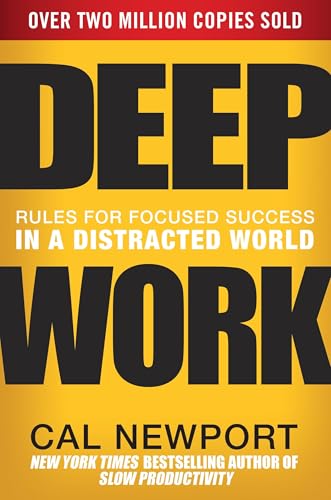
Deep Work: Rules for Focused Success in a Distracted World
Newport’s companion argument — this one is about what you do with the attention you reclaim. Read them together.
Check Price on Bookshop →
Essentialism: The Disciplined Pursuit of Less
McKeown’s version of the same core insight — protect the essential by eliminating the non-essential. Different lens, same discipline.
Check Price on Bookshop →Subscribe to the weekly newsletter for more honest reviews, reading recommendations, and the occasional opinion delivered without apology. Sign up here — no algorithm decides what you see, which feels appropriate given the book we just discussed.
Now I want to hear from you. Have you tried a digital declutter — formal or informal? Did it stick? What surprised you most about stepping back from the feeds? Drop it in the comments. I read every one, and this is exactly the kind of conversation worth having somewhere other than a social media platform.


