

Deep Work by Cal Newport: Review
Affiliate disclosure: This post contains affiliate links. If you buy through them, I may earn a small commission — at no extra cost to you. I only recommend things I’ve actually read, used, or genuinely believe in.

Deep Work
Deep Work by Cal Newport: An Honest Review for People Who Keep Getting Interrupted
Why I Finally Read This Book (Spoiler: AI Shamed Me Into It)
Here’s the situation. It’s 2026. CEOs spent the last three years promising us that AI would handle the grunt work so we could finally do the real thinking. You know — the deep, meaningful, career-defining kind. And according to Fortune’s March 2026 report, the opposite happened. Focused work sessions dropped 9%. Nine percent. AI didn’t free us — it handed us a firehose of notifications, summaries, and “quick action items” that wrecked whatever concentration we had left.
I felt that in my bones. My deep work review of Cal Newport’s landmark book is coming from a very specific place: a 62-year-old man who remembers what it felt like to sit down with a legal pad and a problem and actually solve it. Before Slack. Before five open browser tabs. Before I asked an AI chatbot to summarize the article I was already reading. Newport’s Deep Work isn’t new — it came out in 2016 — but it’s never been more necessary than right now, in this exact moment, when the whole culture is sleepwalking into shallow.
Book Info at a Glance
Title: Deep Work: Rules for Focused Success in a Distracted World
Author: Cal Newport
Publisher: Grand Central Publishing
Published: January 5, 2016
Pages: 296
Genre: Productivity / Self-Development / Business
Ken’s Rating: ⭐⭐⭐⭐½ (4.5 / 5)
Best For: Knowledge workers, writers, creators, anyone whose brain is their primary tool
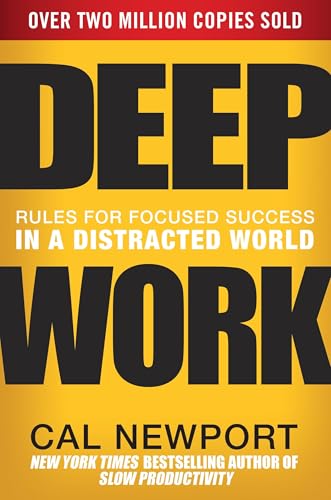
Deep Work: Rules for Focused Success in a Distracted World
Cal Newport’s argument that deep focus is the superpower of our era — and a step-by-step system for actually building it.
Check Price on Bookshop →The Bottom Line (For People Who Won’t Read the Whole Review)
Deep Work is the clearest, most practical case ever made for protecting your brain from distraction — and then actually using it. Newport proves that sustained, focused effort on hard things is both increasingly rare and increasingly valuable. The book has real structural problems — it’s repetitive and overlong — but the core argument is airtight and the strategies work. If you only read one productivity book this decade, let it be this one. Full stop.
What This Book Is Actually About
Newport opens with a killer contrast. On one side: Carl Jung, building a stone tower in the Swiss woods to do his best thinking, away from the madness of his Zurich clinical practice. On the other side: the modern open-plan office, where everyone is visible, available, and — Newport’s word — shallow.
Deep work, Newport argues, is “professional activities performed in a state of distraction-free concentration that push your cognitive capabilities to their limit.” Shallow work is the opposite — the emails, the meetings, the administrative churn that feels productive but isn’t creating anything new or valuable. His thesis is blunt: deep work is becoming rare just as it’s becoming more economically valuable. Therefore, the person who can do it — and protect the ability to do it — wins.
The book is split into two halves. Part One makes the case. Part Two gives you the rules: four rules for restructuring your working life around focused effort. Newport draws from neuroscience, economics, and a lineup of serious thinkers — from the novelist Willa Cather to tech entrepreneur Jason Fried — to make the argument stick.
Writing style: Newport is a computer science professor at Georgetown, and the prose reflects that — organized, evidence-heavy, never showy. It won’t set your hair on fire the way a Malcolm Gladwell book might. But it’s clear, and clarity is exactly what the subject demands.
Quick Pros and Cons
- ✅ Airtight central argument
- ✅ Concrete, actionable strategies
- ✅ Rooted in real case studies, not abstract theory
- ❌ Repetitive in places — Newport makes the same point four different ways when two would do
- ❌ The “four rules” structure feels slightly artificial by the end
Theme 1: The Deep Work Hypothesis — and Why It Actually Holds Up in 2026
Newport’s central claim is that two groups will thrive in the new economy: those who can work with intelligent machines, and those who are so good at what they do that they’re irreplaceable. Both skills, he argues, require deep work — the ability to sit with a hard problem long enough to actually solve it, rather than skim the surface and move on.
When I first read that in 2016, it felt prescient. Reading it again in 2026? It feels like prophecy that came true and then got way worse. That Fortune report about focused work sessions dropping 9% isn’t a footnote — it’s the punchline to a joke Newport set up a decade ago. We were warned. We didn’t listen. We installed more apps.
Newport is particularly sharp when he dissects what he calls the “metric black hole” of knowledge work. In manufacturing, productivity is measurable. But when your job is thinking, it’s hard to prove you’re doing it — so organizations default to what looks like productivity: fast email responses, lots of meetings, visible busyness. He calls this “pseudo-productivity,” and the term stings because it’s accurate.
Here’s what hit me personally. Since I got sober in July 2023, I’ve been genuinely rebuilding my relationship with how I spend time. In early recovery, every idle moment felt dangerous — so I filled them with noise. Endless scrolling, constant half-tasks, a podcast in my ears at all times. Newport’s book gave me a different frame: that the discomfort of sitting with a hard problem, of being bored for a few minutes before the thinking kicks in, is not something to flee. It’s the actual door. Walk through it.
The hypothesis holds. Possibly better now than when he wrote it.
Theme 2: The Four Rules — What Works, What Feels Forced
The second half of the book is where Newport earns his keep as a practical writer. He gives you four rules. Here they are, with my honest assessment of each.
Rule 1: Work Deeply
This is the meat. Newport lays out four “depth philosophies” — monastic (extreme isolation, like a hermit), bimodal (long chunks of deep work alternating with accessible periods), rhythmic (same time every day, no drama), and journalistic (fitting deep work in whenever you can). I’m a rhythmic guy. Every morning, before the email, before the news, before my husband is fully awake — I have two hours that belong to the work. Newport validated that instinct and sharpened it. The philosophy framework is genuinely useful because it acknowledges that not everyone can build a stone tower in Switzerland, and not everyone’s job allows for monastic withdrawal. Pick your mode. Defend it.
Rule 2: Embrace Boredom
This one stings. Newport argues that if you reach for your phone every time you’re bored — in line at the grocery store, waiting for a web page to load, during the commercial break — you’re training your brain to be incapable of focus. You’re teaching it that discomfort means escape. The fix isn’t just to do less social media. It’s to schedule your distraction and resist it outside those windows. Brutal. Correct.
Rule 3: Quit Social Media (Or At Least Be Honest About It)
Newport doesn’t demand you delete everything. He wants you to apply what he calls the “craftsman approach” — only use a tool if its benefits clearly outweigh its costs. Most social media fails that test when you’re honest about it. I’ve done my own version of this — a 30-day digital detox that genuinely changed how I use my devices. Newport’s framework explains exactly why it worked.
Rule 4: Drain the Shallows
Schedule every minute of your workday. Not to be rigid — to be intentional. Newport’s advice to categorize every professional activity as “deep” or “shallow” and then aggressively minimize the shallow is both obvious and radical. The specific tactic of capping shallow work at a fixed percentage of your day (his suggestion: no more than 30-50% for most knowledge workers) is something I’ve actually implemented. It changes how you look at your calendar.
Writing Style and Craft: Solid, Not Sparkling
Newport writes like a man who is very sure he’s right — which he largely is, so it works. The prose is clean and organized. He’s got a gift for the right example at the right moment: Adam Grant’s batched work schedule, the novelist Neal Stephenson who famously refuses email, the physicist Richard Feynman creating elaborate systems to protect his thinking time. These aren’t decorative. They’re structural — each one advances the argument rather than just dressing it up.
Where the writing falters is in the repetition. Newport restates his core thesis so many times that by Part Two, you start to feel like the professor who reminds you of the exam date every class session. It’s the book’s main vice. A sharper editor would have cut 60 pages and made it tighter and more devastating.
That said — compared to the hollow, buzz-wordy competitors in this genre — Newport’s writing is a breath of clean air. No “synergy.” No “leverage your authentic self.” Just: here’s what the evidence shows, here’s what it means, here’s what to do about it. If you’ve ever read productivity books that felt like a motivational poster stretched to 300 pages, this one will feel like a cold shower. In the good way.
Audiobook: Worth Your Commute
The audiobook is narrated by Jeff Bottoms, and it’s solid. He reads at a brisk, authoritative pace that matches Newport’s style — no dramatic flourishes, no faux-inspirational swells. Just the argument, delivered clearly. Running time is about seven and a half hours.
One honest caveat: some of this book benefits from slow reading. The sections where Newport walks through scheduling strategies or the “deep work budget” concept are easier to absorb with a pencil in hand than through earbuds while walking the dog. I’d say: listen to Part One (the argument), read Part Two (the rules). Best of both formats.
Emotional Impact: Mostly Bracing, Occasionally Annoying
I want to be honest with you here, because this is where most reviews go soft. Parts of this book made me uncomfortable in ways I didn’t entirely enjoy. Newport’s critique of people who are chronically distracted is clinical and correct and — if you’re one of those people, which I was — mildly humiliating.
There’s a section where he describes watching knowledge workers spend their days bouncing between shallow tasks and concludes that they “no longer know what to do with themselves” when given actual unstructured thinking time. Reader, he was describing me circa 2022.
But the book isn’t punishing. Newport isn’t writing from a place of contempt — he’s writing from a place of genuine alarm about what distraction culture is costing us, individually and collectively. And he gives you a way out. That combination — honest diagnosis plus real prescription — is what makes this book land emotionally, at least for readers who are willing to sit with the discomfort for a minute.
It connects, for me, to something I’ve noticed in recovery: that the real work — the fourth step, the inventory, the honest accounting — requires exactly the kind of sustained, distraction-free focus Newport is describing. You can’t skim a fourth step. And you can’t skim the work that makes your life worth something, either.
What’s Brilliant (and What Made Me Want to Throw It Across the Room)
Three Things Newport Gets Absolutely Right
- The economic argument is bulletproof. Newport frames deep work not as a self-help virtue but as a market advantage. In a world where AI is eating shallow cognitive tasks for breakfast, the ability to think hard and well is not just nice to have — it’s the differentiator. This reframing alone is worth the price of the book.
- The “attention residue” concept changed how I work. Newport cites research by Sophie Leroy showing that when you switch from Task A to Task B, part of your attention stays stuck on Task A — leaving you with a diminished cognitive resource for the new thing. Every time you check your phone mid-project, you’re leaving a chunk of your brain back at the phone. This single idea reorganized my entire morning.
- The scheduling strategies are specific and usable. Newport doesn’t just say “focus more.” He gives you the time-block planning method, the deep work shutdown ritual, the fixed-schedule productivity system. These are real tools. I’ve used three of them. They work. Check out my notes on desk and productivity tools that actually work for some of what I pair with these strategies.
Two Places Where Newport Drove Me Nuts
- He ignores privilege almost entirely. Newport’s deep work practitioners are overwhelmingly academics, authors, and executives — people who have genuine structural control over their schedules. If you’re a nurse, a teacher, a customer-service rep, or a parent of young children, a lot of this advice bounces off the reality of your life. Newport acknowledges this briefly and moves on faster than he should.
- The repetition is genuinely excessive. I counted three separate places where he re-explains why shallow work is dangerous. Once is necessary. Twice is acceptable. Three times suggests the book needed a harder edit. If you’re reading and you start to feel like you’re hearing the same sermon for the third time — you are. Push through. The material underneath is worth it.
Who Should Read This Book
Anyone whose primary professional output is thinking — writers, developers, astrologers, analysts, creators, researchers, consultants. Anyone who feels like they end the day exhausted but wonders where all the actual work went. Anyone who has ever sat down to do something hard and spent 45 minutes doing easier things instead. And honestly? Anyone in recovery who’s rebuilding a relationship with how they spend time and attention. This book is a practical companion to that work. It pairs naturally with James Clear’s Atomic Habits — one builds the systems, the other protects the space those systems need.
The Verdict
This deep work review comes down to one question: does the book do what it sets out to do? Yes. Emphatically. Newport makes a case so solid that it’s hard to put the book down and go back to your old habits without at least a twinge of guilt — and guilt, here, is productive. It means the argument landed.
Is it perfect? No. It’s repetitive. It underserves people who don’t control their own schedules. And Newport’s monkish certainty can tip into smugness if you catch him on the wrong page. But the core — the actual intellectual architecture of what deep work is, why it matters, and how to do it — is some of the clearest thinking in the productivity genre. And the genre is crowded with books that deserve to be kindling.
I read a lot about focus and distraction these days — partly because I need the reminders, partly because the topic genuinely fascinates me. I’ve experimented with noise-canceling headphones to protect my work blocks. I’ve tried mind mapping tools to get complicated thinking out of my head and onto a surface I can work with. All of that infrastructure is more effective because Newport taught me why it matters — not just that it might help.
Four and a half stars. Buy the book. Read Part One on a weekend. Implement one rule from Part Two the following Monday. Come back and tell me which one you started with.
Further Reading: Three Books That Belong on the Same Shelf

Digital Minimalism: Choosing a Focused Life in a Noisy World — Cal Newport
The natural companion to Deep Work — Newport’s case for radically simplifying your digital life so real focus becomes possible. Read this one second.
Check Price on Bookshop →
Atomic Habits: An Easy & Proven Way to Build Good Habits & Break Bad Ones — James Clear
Where Newport tells you what deep work is and why it matters, Clear tells you how to build the daily habits that make it automatic. The two books together are the full toolkit.
Check Price on Bookshop →
So Good They Can’t Ignore You: Why Skills Trump Passion in the Quest for Work You Love — Cal Newport
Newport’s earlier book is the philosophical foundation under Deep Work — the argument that rare and valuable skills, built through deliberate practice, are what create a fulfilling career. Start here if you want the full arc of Newport’s thinking.
Check Price on Bookshop →Now It’s Your Turn — I Mean That
Today is Thursday — which means it’s a good day to start a fight about something, productively. So here’s my question for the comments: Where do you actually do your best thinking? Not where you’re supposed to — where it actually happens. And what’s the single biggest thing that wrecks it?
I’ll go first: my best thinking happens in the first 90 minutes after I wake up, before I’ve opened anything with a notification badge. What wrecks it is my own curiosity — I think of something I want to look up, and forty minutes later I’ve read three articles and forgotten what I was actually trying to do. Newport has a fix for that too. Come argue with me below.
And if this review was useful, do me a favor — subscribe to the weekly newsletter. More tips, more honest book takes, more tools I’ve actually used. The signup is right here on ken-saunders.com. No spam. Just the good stuff.
Sources consulted: Deep Work on Goodreads (ratings and reader reviews). Fortune reporting on AI and focused work, March 2026.
Get Ken’s newsletter
Honest reviews and curated finds — the gear, gadgets, books, and recipes actually worth your money. No spam, unsubscribe anytime.


